








As Democrats search for ways to compete in conservative states during the Trump era, former Kentucky state Representative Charles Booker believes he has an answer: organize everywhere, speak directly to working-class frustrations, and build the kind of statewide infrastructure that helped Mitch McConnell dominate Kentucky politics for decades.
Read more Heavy Snow Warning As 12 Inches To Hit Washington, Montana, Oregon
In a Zoom interview with Newsweek on Wednesday, less than a week before Kentucky primary on Tuesday, Booker argued that his campaign has been organizing in communities where national Democrats have often struggled to compete, including rural and working-class areas that have voted heavily for President Donald Trump.
“Kentucky is much, much more than a red state,” Booker said. “It’s a marginalized state. It’s a disenfranchised state. It’s a forgotten state. It’s the state of people who are hard-working, who put faith in action every day but have been screwed over by politics.
“People are tired of that. I’m still the underdog as far as being outspent, but we’re the front-runner because we have the people with us.”
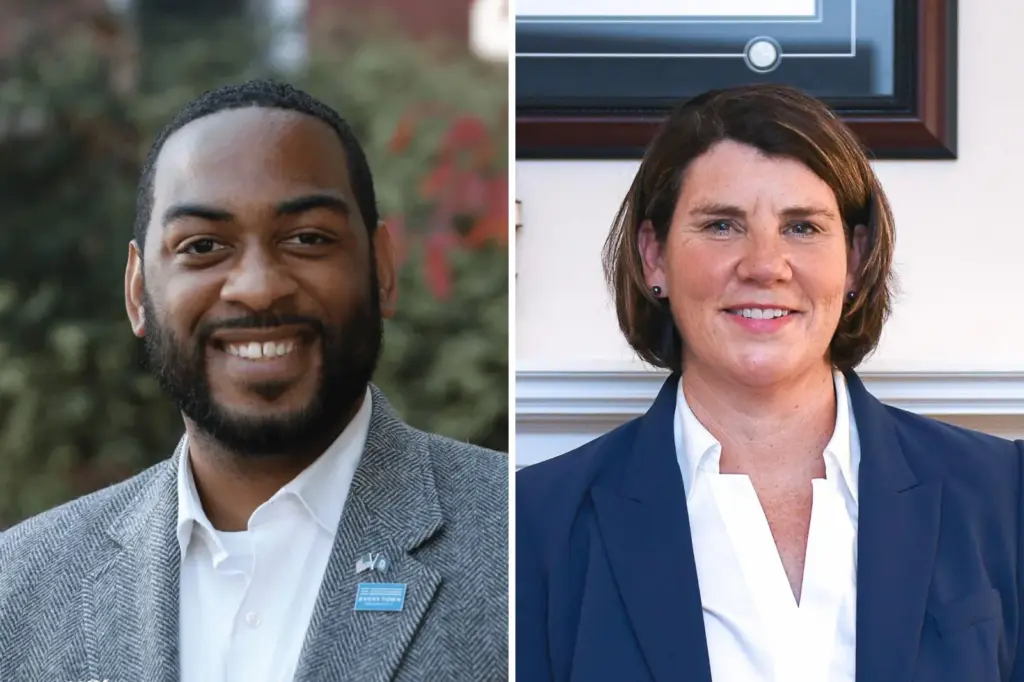
Booker, who has twice run for Senate in Kentucky, is the front-runner in the Democratic primary. If he makes it to the general election, he will face a Republican opponent in the race to replace McConnell, a Republican who is retiring after more than 40 years in Congress—which included a record-breaking nearly two-decade stint as the Senate GOP leader.

The Democratic primary winner is expected to face a difficult general election in one of the nation’s most reliably Republican states. Kentucky voted overwhelmingly for Trump in recent presidential elections, and Democrats have not won a Senate race there since Wendell Ford’s 1992 reelection.
But the state’s Democratic governor, Andy Beshear, won statewide in 2019 and again in 2023, proving that a Democrat can still build a winning coalition in the Trump era if enough Republicans and independents cross over. Beshear also continues to be the most popular Democratic governor and third-most popular overall in the U.S., according to polling data from Morning Consult.
How Charles Booker Plans to Win in Kentucky
Booker’s argument is that he can tap into some of the same political frustration Beshear has benefited from while running a more explicitly populist campaign focused on wages, healthcare and economic power.
“In a lot of ways, it’s a populist message,” Booker said. “Kentucky’s been one of the poorest states in the country. And I’m from the hood, I’m the west end of Louisville, and we would have never said we were poor, but we didn’t have any money.”
He tied his biography directly to his campaign pitch.
“I’ve been homeless. I’m a type-1 diabetic. I’ve had to ration my insulin to feed my girls,” Booker said. “And so when I talk about issues across Kentucky, I don’t show up as a Democrat, I show up as a father of three girls and someone who knows what it means to fight for family.”
Booker’s policy agenda includes Medicare for All, higher wages, paid sick leave and universal basic income. He described his wage proposal as part of a “working people’s bill of rights.”
“If you work a minimum of 40 hours a week, you should receive a minimum salary of at least $45,000, 40 hours paid sick time,” he said. “I’m telling you, we need Medicare for all. We’re already paying for it. We’re sending money for bombs, money to people like Jeff Bezos. We need Medicare for all. It’s not just a healthcare policy, it’s an economic policy, it’s a justice policy.
“No one should have to die because they don’t have enough money in their pocket in the wealthiest country in the world.”
Can a Progressive Win in a Red State?
Booker’s positions have drawn criticism from Democrats and Republicans. His top Democratic rival, former Marine fighter pilot Amy McGrath, who has also run unsuccessfully for Senate, said her opponent is too far left to win in Kentucky.
In an interview with the Kentucky Lantern, she characterized Booker as “so far left” that she was not sure “he could get elected in New York City.” McGrath told the outlet that the primary “comes down to who is the best candidate to be able to take on whatever Republican gets through the other side and have a credible campaign that can win in a state like Kentucky.”
Republicans have also moved quickly to define Booker as outside Kentucky’s mainstream.
Booker said: “I’ve been called the Mamdani of Kentucky,” referring to recently elected New York City Mayor Zohran Mamdani, who identifies as a Democratic Socialist. Conservatives have dubbed the Kentucky Democrat “a radical socialist.” But he dismissed the criticism as disconnected from what voters are telling him.
“They’re not paying attention to the people of Kentucky,” he said of Democrats who argue a progressive cannot win statewide. “They’re talking to pundits. They’re taking the consultants. They are not, they’re not up in the hollows, like I’ve been. They are not on the corner, like I’m being. They aren’t on the picket line, like I have been.”
He said voters in conservative areas often care more about practical concerns than partisan labels.
“Folks in Appalachia who may have voted for Donald Trump, they want clean water,” Booker said. “They want utilities they can afford. They wanna be able to make sure their children are safe.”
Taking ‘Pages’ From Mitch McConnell
In his campaigning, Booker said he’s learned lessons from McConnell, who transformed the state’s Republican infrastructure across decades in power.
“I’ve taken pages from Mitch McConnell,” he said. “Mitch McConnell built the Republican Party in Kentucky by driving resources into areas that were ignored by lifting up voices that were forgotten about.”
Read more Golden Knights Forfeit Draft Pick as Part of Major NHL Punishment
Booker added that he has been doing similar work through grassroots organizing “from the hood to the holler.”
“We’ve been building infrastructure,” he said. “We’ve been organizing, inspiring people to get involved in a democratic process who don’t typically vote.”
Where Democratic Race Stands Ahead of Kentucky’s Primary
Booker appears to be leading ahead of the Kentucky primary on Tuesday, but he faces significant headwinds.
The most recent public primary poll, conducted by Emerson College from March 29-31, showed Booker at 36 percent among likely Democratic primary voters, Amy McGrath at 18 percent, Pamela Stevenson at 3 percent and 38 percent undecided. In Emerson’s previous poll, conducted January 31-February 2, Booker led McGrath 30 percent to 19 percent.
Kalshi’s prediction market on Friday showed Booker with a 91 percent chance of winning, while McGrath came in a second at less than 7 percent. Polymarket’s odds were similar.
The financial picture has also highlighted the contrast between the campaigns. Federal Election Commission data shows McGrath, a former Marine fighter pilot and the party’s 2020 Senate nominee, had raised $1,942,704 and spent $1,631,150 through March 31. Booker had raised $508,684 and spent $368,375 through April 29.
Booker pointed to that gap as evidence, saying that his campaign’s strength is not based on money alone. McGrath is running on military service, national security credentials and a more moderate posture. Stevenson, the Kentucky House Democratic leader, is emphasizing legislative experience. Dale Romans, a horse trainer, has pitched himself as a pragmatic Democrat who can appeal to conservative-leaning voters, while Logan Forsythe, a former Secret Service agent, has argued that Democrats must show up more consistently across the state.
Romans has criticized parts of Booker’s platform as unrealistic, telling the Kentucky Lantern: “You can get up there and spew off anything you want to say early, knowing that it can never be done. And I’ve never gone down that road.” He added: “I’m a pragmatic Democrat that a Republican doesn’t have to be afraid to vote for.”
Can Booker Win in Kentucky General Election?
Booker’s challenge, if he wins the nomination, will be turning primary enthusiasm into a broader general-election coalition. Prediction markets and major race raters continue to favor Republicans in November, even as Democrats expect 2026 to be a favorable national environment. Kentucky’s Republican lean means a good Democratic year may not be enough on its own.
Booker acknowledged that he would need voters who may disagree with him on some cultural issues. The son of ministers, he framed his appeal to socially conservative voters around the limits of government power.
“I’m a preacher’s kid, both my parents are ministers, grew up in a Pentecostal church,” Booker said. “And, you know, I understand deeply held convictions of faith.”
But he added: “I also believe it is not the government’s job to legislate morality. It’s not the governments job. To be the arbiter of faith.”

Impeaching Donald Trump and Ousting Chuck Schumer
On Trump, Booker was more confrontational. Asked how he would work with the Trump administration if elected, Booker said he would be “relentless” about delivering for Kentucky but also argued that Trump and his allies “know very well what’s coming” if Democrats flip the seat and the Senate.
“He needs to be impeached. He needs be removed and he needs to be arrested,” Booker said. “We know he has broken the law, violated the Constitution. We know that we have the responsibility in the Senate to hold this corruption accountable.”
That position could appeal to Democratic voters while also giving Republicans a clear line of attack in a state Trump has carried easily.
Booker also made clear that he would not be a reliable vote for the current Democratic leadership. Asked whether he would support Chuck Schumer as Senate Democratic leader, Booker said: “No, I think we need new leadership.”
“I’m going to the U.S. Senate to change the status quo,” he said, “and a lot of the folks who have been the arbiters of the status quo, even with the best of intentions, we need real change.”
He said Schumer “was working against me in 2020 because he didn’t think that Kentucky was ready for the change that we’re bringing now.”
For Booker, the race is about more than one open Senate seat. He sees it as a test of whether Democrats can compete in conservative places by combining progressive economics with long-term organizing.
“This race will show that the pursuit of democracy is still alive,” he said, “that you can stand up for humanity, that you build coalitions, that you lift up working people and win.”