








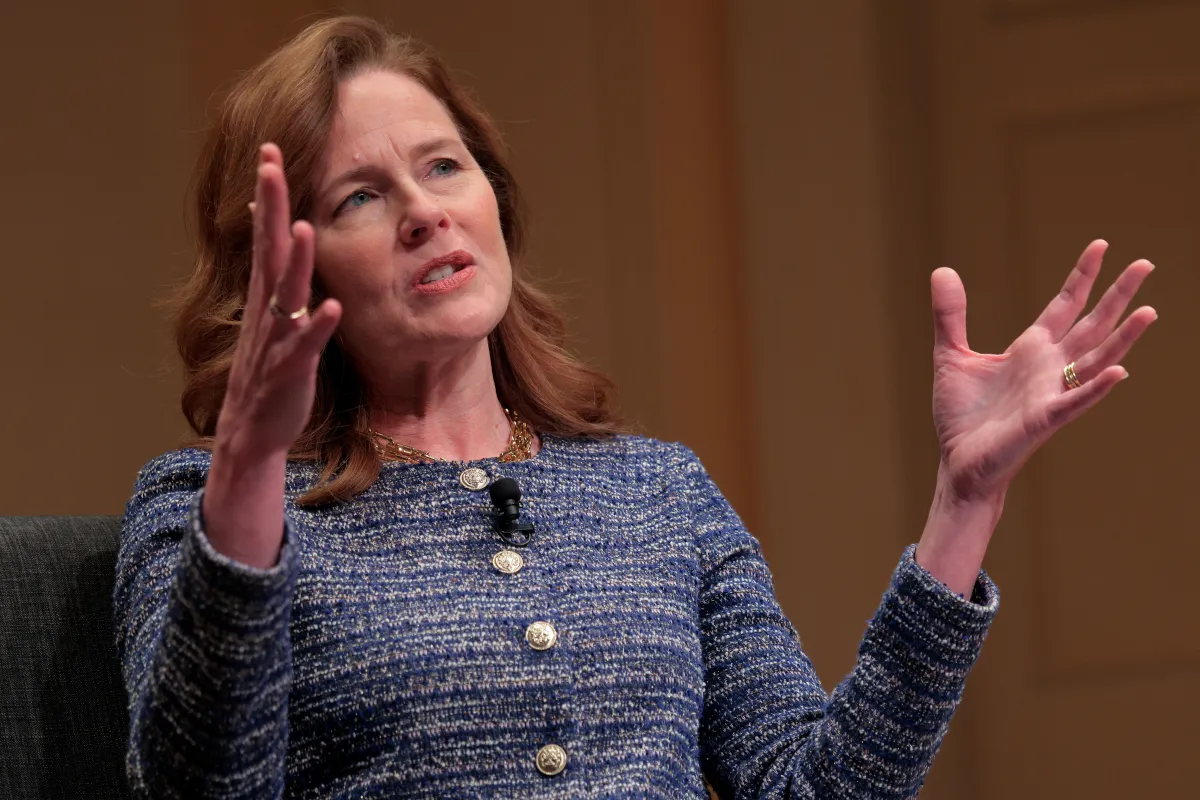
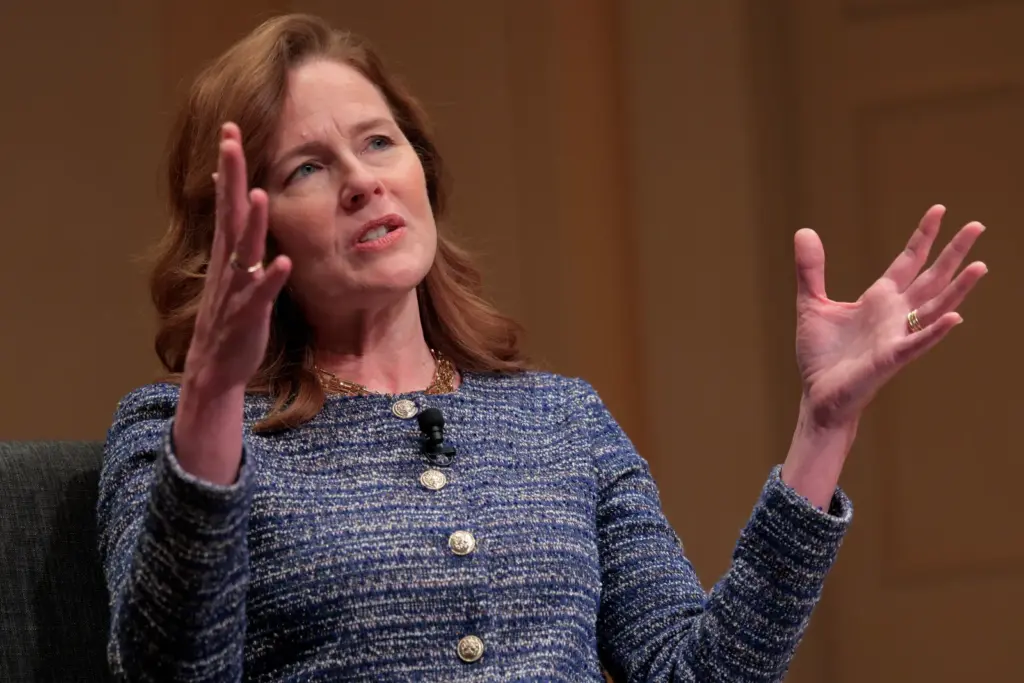
U.S. Supreme Court Justice Amy Coney Barrett has likely recused herself from a case involving a federal inmate who assisted in a high-profile cartel investigation due to her prior involvement in the litigation during her tenure on the lower courts.
Read more Kenny Atkinson Heaps Praise on Donovan Mitchell After Game 7 Win
Andrew Johnston, an inmate currently held at the Metropolitan Correctional Center in Chicago, petitioned the Supreme Court to review his sentence, but his request was denied for a second time. Had the court granted his petition for a writ of certiorari, it would have forced the Seventh Circuit Court of Appeals to review a lower district court’s decision denying Johnston a full 25 percent sentence reduction.
The conservative justice never formally explains why she sits out a case, but a Newsweek review of documents shows a previous tie to this one that likely explains why she won’t rule on the case now, or ever.
Why Did Amy Coney Barrett Sit Out the Case?
Though Barrett did not formally explain her decision to abstain, records from a 2020 appeal clarify her conflict of interest. Johnston has filed at least two writs of certiorari with the Supreme Court in an effort to compel the Seventh Circuit to hear his appeals.
In a handwritten 2020 petition, Johnston noted that he was convicted in 2019 and sentenced to 168 months in prison. He stated that he submitted his notice of appeal to the courtroom clerk immediately following his sentencing—the exact juncture where Barrett became involved in the case.
“After correcting petitioner’s financial status on or about April 17, 2019, Circuit Judge, Amy C. Barrett, granted petitioner leave to prosecute his appeal pro se on May 3, 2019,” Johnston wrote in his first appeal to the court.
By granting Johnston pro se status, Barrett authorized him to act as his own attorney. In her 2019 order, Barrett noted that if Johnston later desired court-appointed counsel, he would need to file a formal motion. She explicitly clarified that neither his former standby counsel nor his fiancée could electronically file documents on his behalf. Johnston subsequently alleged that he was “denied access to his transcripts” and that his “conditions of confinement were manipulated to hinder his ability to prosecute the appeal.”
Consequently, when Johnston first appealed to the Supreme Court in 2021, Barrett recused herself, according to records reviewed by Newsweek. According to an order list released on Monday, Johnston filed a subsequent appeal this year, prompting another recusal from Barrett. The decision almost certainly stems from her initial 2019 ruling on the Seventh Circuit, made prior to her appointment to the nation’s highest court.
Why Amy Coney Barrett Doesn’t Explain Her Recusals
While Barrett declines to comment on individual recusals, she has previously outlined the broader judicial philosophy behind keeping such decisions private.
Read more What Leads to Fighter Jets Crashing Into Each Other?
Speaking to an audience in September to promote her new book, Barrett explained that requiring justices to state their reasons for stepping aside carries institutional “costs.” She noted that the vast majority of recusals stem from financial conflicts, which are already accessible to the public by mandatory federal financial disclosures. She also emphasized that justices traditionally recuse themselves from reviewing cases they previously ruled on during their tenures on lower courts.
However, Barrett pointed out that certain recusals involve sensitive personal connections, such as relationships with friends or family members. She argued that if a justice begins explaining recusals case-by-case, they would be forced to do so consistently “across the board.”
“But I have to think too about, well, is it really something I want to do … to identify that person and then put that person in that position? So, I just sort of feel like, when you think about the full range of reasons across the board, I don’t know what might arise in the future, so it’s just better not to say,” she said at the time.
What Andrew Johnston’s Case Is All About
Johnston’s underlying legal battle began with a conviction for attempted bank robbery, which carried a 168-month prison sentence imposed by the U.S. District Court for the Northern District of Illinois. While incarcerated, Johnston began cooperating with federal authorities in an unrelated, sensitive investigation targeting a prominent member of the Sinaloa Cartel.
As part of his cooperation, Johnston intercepted a conversation with the cartel figure, who revealed that his motivation for pleading guilty was to prevent Damaso Lopez-Serrano—the godson of notorious drug lord Joaquin “El Chapo” Guzman—from testifying against him. Johnston also directed his girlfriend to alert prison officials to an active contract on Lopez-Serrano’s life, successfully thwarting the plot. According to court filings, Johnston later wore a concealed recording device within his cell block to gather evidence and ultimately testified against the cartel member in open court.
In exchange for his cooperation, the government moved to reduce Johnston’s sentence by 25 percent, but the district court only awarded a 10 percent reduction. The decision was motivated by the court feeling Johnston lacked remorse for the attempted bank robbery.
Johnston appealed the partial reduction to the Seventh Circuit Court of Appeals—the bench Barrett sat on before her Supreme Court confirmation. He argued that the district court improperly factored in elements unrelated to his federal assistance, such as his prior litigation history, and challenged the strict statutory limits governing sentence-reduction reviews.
In an opinion issued on October 29, 2025, the Seventh Circuit affirmed the lower court’s ruling, concluding that district courts retain broad discretion to weigh general sentencing factors—including a defendant’s rehabilitation and remorse—rather than evaluating the value of the assistance in absolute isolation. Johnston subsequently asked the Supreme Court to weigh in on whether a district court may rely on general sentencing principles when deciding whether to grant a post-sentence reduction.
Read more Trump Approval Rating Double-Digits Higher Than Satisfaction With Democrats